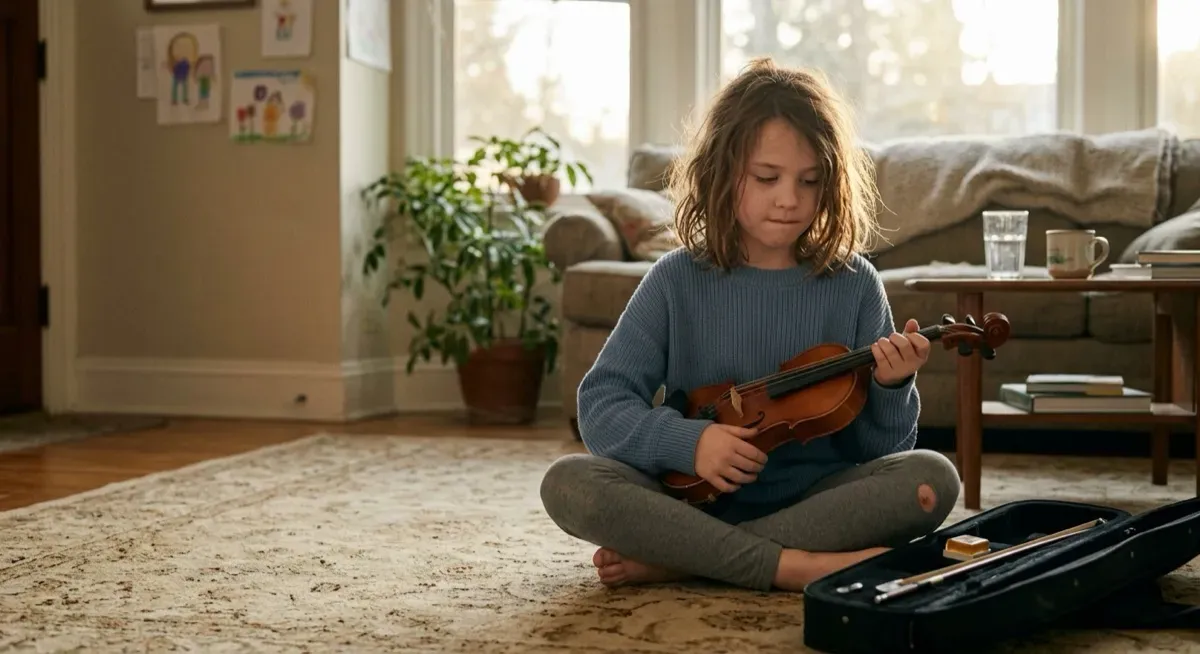
A mom emailed me last spring. Her 9-year-old daughter had been playing for five months. The email said, “She cried before practice last night. She told me she hates violin. I don’t know if I should make her keep going or just let her stop.” I read it twice and felt that familiar tightness in my chest, because I get a version of this message almost every month.
Here’s the short answer I gave that mom. Don’t let her quit yet. But also, don’t push harder. There’s a third path most parents don’t know exists, and it’s almost always the right one.
Why Kids Actually Want to Quit
When a child says “I want to quit,” they almost never mean what the words say. They mean something else, and your job is to figure out what.
I have been teaching since 2012, and I’ve watched this play out hundreds of times. The real reason usually falls into one of four buckets.
- They hit a hard plateau around month 3 or 4 and they feel stupid. This is by far the most common one
- The lesson or practice time competes with something they love more, like a friend’s sleepover, soccer practice, or a new video game
- They’re embarrassed by how they sound and they don’t want anyone in the house to hear them
- Something between them and their teacher isn’t clicking, and they don’t have the words to explain it
Notice what is not on that list. “They don’t like music.” That one is incredibly rare, even when the kid swears it’s the reason. After two decades, I can count the truly music-hating kids on one hand.
Before you decide anything, sit with them. Not at practice time. Not in the car five minutes before lessons. Somewhere quiet, with no violin in the room. Ask them gently, “What’s the hardest part right now?” Then just listen. Don’t fix. Don’t reassure. Don’t explain why it’ll get better. Just listen. You’ll usually hear the real answer in the first two minutes, and it almost never sounds like the words “I want to quit.”
The 6-Month Rule I Live By
If your child has been playing for less than 6 months, my answer is almost always the same. Don’t let them quit yet.
Here’s why. Most kids hit a wall somewhere between month 3 and month 4. They’ve passed the “exciting new toy” stage but they haven’t reached the “I can actually play songs people recognize” stage. That gap is brutal. It feels like the work is endless and the reward is invisible.
But it’s not invisible. It’s coming. Around month 5 or 6, something clicks for almost every kid I’ve ever taught. They play a piece that sounds genuinely musical. A grandparent cries on a video call. A friend asks them to play it again. And suddenly the same kid who wanted to quit two months ago is begging to bring their violin to school for show and tell.
I’ve seen this exact pattern so many times I could write a script for it. The kids who quit at month 4 always wonder later if they would have loved it. The kids who pushed through month 4 almost always say later that they’re so glad nobody let them stop. If you want to know what’s normal at each stage, I wrote a month by month timeline that shows exactly where your child likely is right now.
What “Don’t Quit Yet” Does Not Mean
It does not mean force them. Please hear me on this one. Forcing a child to play violin is the fastest way to make them hate music for the rest of their life.
I’ve had adult students walk into my studio in their 30s and say, “I played as a kid but my mom made me, and I haven’t touched a violin since I was 12.” That breaks my heart every time. The talent was there. The love got crushed by pressure that probably felt small to the parent at the time.
So when I say “don’t let them quit yet,” I mean find the smaller change that fixes the real problem. Not the nuclear option of stopping completely, and definitely not the other nuclear option of forcing them through it.
The Smaller Changes That Usually Work
Before you let your child quit, try these in order. Most of the time, one of them solves the whole thing within two weeks.
Cut practice time in half for two weeks. If they’re doing 20 minutes a day and dreading it, drop to 10. If they’re doing 15, drop to 7. A short, happy practice beats a long, miserable one every single time. I’ve written about why 15 minutes a day genuinely works, and even less is fine if that’s what saves the love for the instrument.
Let them pick what to practice. Not all of it. But part of it. Even one song they chose themselves. Ownership changes everything for a kid. A 7-year-old who picked the song will work twice as hard as the same kid being told what to play. Ask them, “What song do you wish you could play?” and then go find a simple version of it together.
Take a one-week break, not a quit. Tell them clearly, “We’re taking the week off and then we’ll see how you feel.” Most kids miss it by day four or five. I’ve watched this happen so many times. The kid who swore they hated violin on Monday is asking on Friday if they can play just for a minute. That tells you everything.
Try a different format. If your child has only had private lessons, sometimes playing with other kids in a group setting reignites the whole thing. Playing alone in your bedroom feels completely different from playing alongside other kids your age who are also figuring it out.
Talk to the teacher honestly. A good teacher genuinely wants to know if your child is struggling. We can change pieces, slow the pace down, switch the style of music, focus on something fun for a few weeks. Don’t suffer in silence assuming the teacher already knows what’s happening at home, because we usually don’t.
When Quitting Actually Is the Right Call
I have to be honest with you. Sometimes the answer really is yes, let them stop. I’d be doing you a disservice if I pretended otherwise.
If your child has been playing for more than a year, you’ve tried real adjustments, and there’s genuine distress instead of just normal frustration, please listen to them. Music is supposed to add something to a child’s life. When it becomes the main source of misery in the house, the math has stopped working.
I had one student, a sweet and serious 10-year-old, who tried violin for almost two years. Her mom and I tried everything I just listed and a few things I didn’t. New pieces, shorter practice, group lessons, breaks. She just never connected with it. Her real love was theatre. When her mom finally told her, “Okay, you can stop,” the relief on that kid’s face told us both we had made the right call. She does community musicals now and she lights up every stage she walks onto.
Letting a child quit when it’s genuinely time is not a parenting failure. It’s respecting who they actually are instead of who you hoped they’d be.
The Question I Wish More Parents Asked
Instead of asking “should I let my child quit violin,” try asking this instead. “What does my child need to fall back in love with this?”
That question opens up so many doors. Maybe they need a smaller, exciting goal, like learning a song from a movie they love. Maybe they need a duet with a parent or a sibling so it feels less lonely. Maybe they need a break from sheet music for a few weeks to just play by ear and have fun. Maybe they need a recital they’re actually excited about instead of one they’re dreading.
Music is supposed to make us feel things. When kids stop feeling anything but pressure, the music itself is gone. Bring back the feeling, and the playing almost always comes back with it.
What to Remember
- Most kids who want to quit are stuck in a normal plateau, usually around month 3 or 4, not actually done with violin
- Wait until at least 6 months of consistent lessons before considering a real stop
- Forcing kids to play creates lifelong resentment toward music. Smaller changes almost always solve the real problem
- Try cutting practice time in half, letting them choose a song, or taking a one-week break before deciding
- An honest conversation with the teacher usually fixes more than parents expect
- Sometimes quitting is genuinely the right answer. If your child has truly given it a fair shot, trust them
If your child is stuck in that frustrating middle stretch and you want a low-pressure way to make practice feel fresh again, my free 4-video beginner series gives them a different teacher’s voice for a few short sessions. Sometimes a small reset is all it takes to remember why they started.
And if you’d like me to meet your child and help figure out what’s actually going on, I’d love to help. Book a private lesson and I can hear them play, talk with both of you, and help us all decide together what would really work.