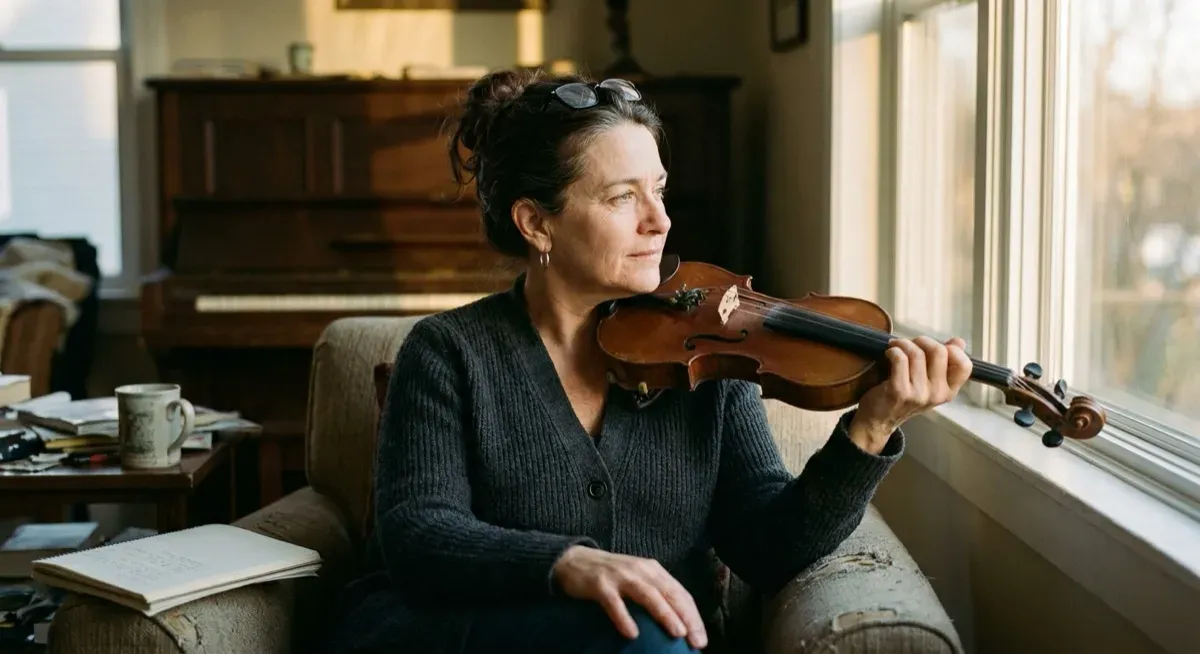
“How long until I can actually play something?” I hear this in almost every first lesson. Sometimes it comes with a nervous laugh, sometimes with genuine worry. The honest answer is that you’ll play a recognizable tune within a month. You’ll sound genuinely musical within six. But let me give you the real picture. The messy, honest, nobody-talks-about-this version.
What Will I Sound Like After One Month?
Scratchy. Uneven. And then, out of nowhere, one beautiful note that surprises you so much you almost stop playing.
You’ll be working on holding the violin and bow correctly, bowing open strings, learning your first finger placements. The sound quality is rough because your muscles are literally learning new movements they’ve never done before. This is completely normal. Every professional violinist you admire sounded exactly like this at week three. I sounded like this. My teachers sounded like this.
Here’s what worries me about this month. It’s when most people quit. They think they’re “bad at it.” You’re not bad at it. You’re a beginner. Those are two very different things. Being bad means you’ve tried and failed. Being a beginner means you haven’t had enough time yet. Give yourself that time. Please.
What About After Three Months?
This is when I start to see my students light up. You can play simple melodies like Twinkle Twinkle, folk tunes, maybe something you chose yourself. People in your house can identify the song, and they’ll probably hum along, which is the sweetest thing.
Your tone is getting warmer, though it still cracks sometimes. You’re working on smoother bow changes, basic rhythm patterns, first and second finger positions. If you’ve been following a structured practice approach, you’ll have 3-5 pieces you can play through.
I love this stage because students start to believe in themselves. That doubt from month one starts melting away.
When Does It Start Sounding Actually Good?
Around months 4-6. That’s when something clicks for most of my students and it’s honestly magical to witness.
You’re playing more complex melodies, crossing between strings smoothly, and starting to control dynamics. That means playing louder and softer on purpose, not by accident. You can read simple sheet music. Friends and family might actually stop what they’re doing and listen. The first time a student tells me someone asked them to “play that again,” that’s a moment I celebrate with them.
I’ve taught students who reach this point in four months and others who take seven. The difference isn’t talent. I really want you to hear that. It’s not talent. It’s practice consistency. Fifteen minutes every day beats two hours once a week. Every single time.
Can Adults Learn as Fast as Kids?
This question comes with so much unnecessary fear. Yes, absolutely you can learn as an adult. It’s just different.
Adults understand concepts faster. I can explain bow hold mechanics to an adult in one lesson. A six-year-old needs me to show them the same thing every week for a month, and that’s fine. But adults tend to overthink. They get in their own heads, build tension, get frustrated when they’re not immediately good at something.
I’ve taught students who started in their 40s, 50s, and 60s who play beautifully. One of my favorite students started at 58 after retiring. She told me learning violin was the most alive she’d felt in years. Age matters so much less than people think. What matters is showing up.
Does Previous Music Experience Help?
Yes, but probably not the way you’d expect. If you read music or play piano, you skip the theory learning curve. That’s real. But violin technique is its own world. Piano fingers don’t help with bow control. Guitar calluses are actually in the wrong places. Sorry, guitarists.
The biggest advantage previous musicians have isn’t their skills. It’s their mindset. They already know that progress isn’t a straight line. They know that yesterday you couldn’t do it and today you suddenly can and nobody knows why. They know repetition works even when it feels like nothing is happening. That understanding is worth more than any technical head start.
What If I Can Only Practice 15 Minutes a Day?
That’s enough. Genuinely, truly enough.
I’d rather you play 15 focused minutes every day than 2 hours on Saturday. Your brain and muscles need daily repetition to build the pathways. One long weekend session, even a great one, doesn’t do what five short weekday sessions do. The science backs this up, and everything I have seen since 2012 confirms it.
My students who practice 15-20 minutes daily consistently outperform those who do longer but irregular sessions. It’s not even close. So if 15 minutes is what you have, that’s what you have. Don’t feel guilty about it. Feel proud you’re showing up.
How Do I Know I’m Making Progress?
Here’s my favorite trick. Record yourself playing the same piece on the first of every month. Just a quick phone recording. Don’t listen back right away. After three months, play the recordings back to back.
You won’t believe you’re the same person. I’ve had students cry listening to their own improvement. Progress happens so gradually day-to-day that you can’t feel it. But over months? It’s dramatic.
And please, stop comparing yourself to people on social media. That “6-month progress” video? It’s the best take out of 30 attempts, good lighting, probably someone who practices 2 hours a day. Compare yourself to where YOU were last month. That’s the only comparison that matters.
What to Remember
- Month 1. Rough sound, learning holds and open strings. Totally normal, don’t give up
- Month 3. Playing recognizable tunes, tone warming up, confidence building
- Month 6. Actually sounding musical, 5-10 pieces you’re proud of
- 15 minutes daily beats 2 hours on weekends. Consistency is everything
- Adults learn differently than kids but reach the same beautiful places
- Record yourself monthly. You’ll be amazed when you listen back
Starting from zero? My free beginner series covers the very first steps, including bow hold, violin hold, and your first notes. Four short videos, no account needed, just you and your violin.